
Explore Our Services
Explore our range of services designed to help you move forward with confidence, wherever you're headed next.
Full Service Details
Clinical Services & Evidence-Based Care
Below is a detailed list of our offered services and clinical frameworks.
Please Note: Not every treatment is appropriate for every condition. Your specific plan of care will be determined by your doctor based on what is most clinically appropriate for your condition, medical history, and overall health goals.
-
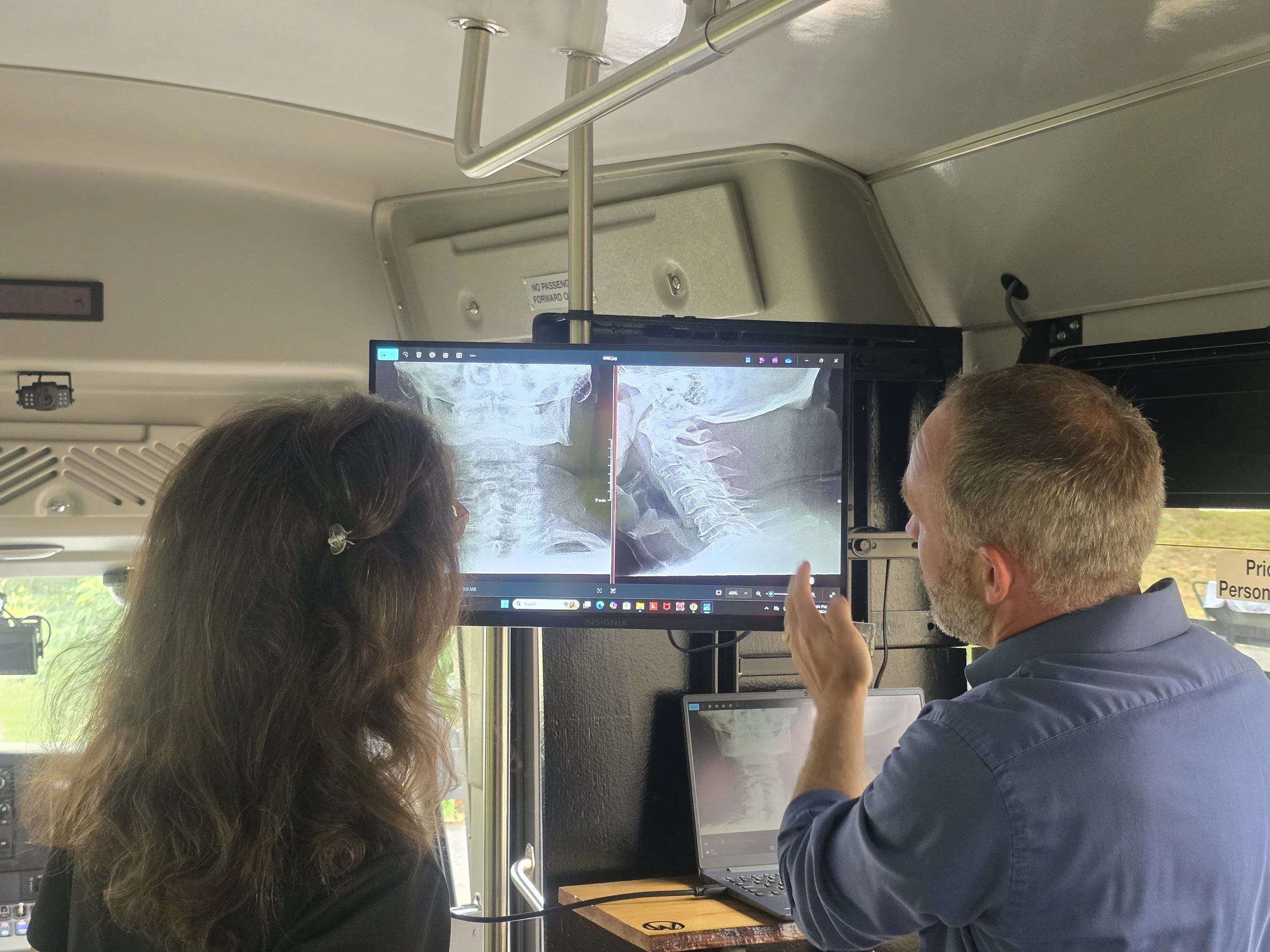
The foundation of safe and effective care is a thorough diagnostic workup. We perform a detailed history and physical examination, including vitals, postural analysis, orthopedic testing, and neurological screening [1,2,3].
Why it matters: Research confirms that a structured physical exam is the most reliable tool for identifying the root cause of pain and ruling out serious pathology [4,5]. When necessary, we coordinate with your broader healthcare team for imaging or specialty referrals.
-
We provide a spectrum of manual therapy techniques ranging from High-Velocity, Low-Amplitude (HVLA) "adjustments" to Gentle Joint Mobilizations (rhythmic stretching). This ensures that patients who are not candidates for HVLA—or simply prefer a lighter touch—receive effective, comfortable care.
Safety Profile: When performed by a trained clinician, spinal manipulation is a remarkably safe, non-drug intervention with a lower risk profile for serious complications than many common over-the-counter pain medications [6-11].
Neurophysiological Effects: Beyond simply restoring joint "play," research suggests SMT has profound effects across the entire neuroaxis. This includes modulating pain at the spinal cord level and influencing cortical processing within the brain and cerebellum [12-14]. While primarily used for musculoskeletal pain, these global neurological effects may offer broader therapeutic benefits, though further research is ongoing in this field.
-
Exercise therapy is the "gold standard" of modern musculoskeletal medicine. We design specific programs to improve strength, stability, and movement coordination tailored to your unique goals.
The Evidence: Clinical guidelines consistently rank exercise as a first-line intervention for reducing pain, improving function, and preventing the recurrence of chronic conditions [15-18].
-
Neuromuscular Re-education focuses on restoring optimal communication between the central nervous system and the musculoskeletal system. This includes balance training, coordination drills, and vestibular-oculomotor integration [1,19].
The Evidence: Clinical guidelines from the NIH and DOD demonstrate that targeted neurological input is essential for recovering from complex conditions and improving neuronal endurance [20-23]. By utilizing principles of neuroplasticity, we rehab the nervous system much like an injured muscle to ensure long-term resilience [24,25].
-
Manual techniques—including trigger point therapy and myofascial release are used to address restrictions in muscles, tendons, and ligaments.
The Goal: To reduce local muscle hypertonicity and improve circulation, which supports the healing of soft tissue injuries and enhances the effectiveness of joint-based treatments [26].
-
Traction involves gently stretching the spine to reduce intradiscal pressure and alleviate nerve root irritation.
Clinical Application: Evidence suggests that mechanical decompression can improve disc hydration and reduce symptoms in patients suffering from radiculopathy (sciatica) or chronic discogenic low back pain [27-29]. Our traction protocols are guided by the clinical research Dr. Alexander conducted during his Master’s practicum, which focused on quantifying the therapeutic forces necessary for treating low back pain.
-
Health is not merely the absence of disease; it is the presence of systemic resilience. We provide evidence-based guidance on sleep hygiene, stress management, and anti-inflammatory nutritional patterns.
The Impact: Addressing lifestyle factors is essential for managing systemic inflammation, optimizing tissue repair, and reducing the risk of metabolic diseases that complicate recovery [30-32].
-
Electrical Stimulation—including Transcutaneous Electrical Nerve Stimulation (TENS) and Interferential Current is used as a targeted tool to "quiet" acute pain and decrease localized swelling [7,33].
The Clinical Goal: By delivering specific frequencies to the affected area, we can modulate the "pain gate" at the spinal cord level [34]. This provides immediate symptomatic relief, allowing for a faster and more comfortable transition into active, movement-based rehabilitation [35].
-
Therapeutic Ultrasound involves the use of high-frequency sound waves to provide deep-tissue thermal and non-thermal effects.
The Evidence: Ultrasound is utilized to improve the extensibility of collagen tissues, such as tendons and ligaments, and to facilitate the cellular repair process [7,26,36]. This is particularly effective for chronic tissue restrictions or acute soft tissue injuries where increasing local circulation is vital for recovery.
-
Cryotherapy (Cold) and Thermotherapy (Heat) are used strategically to support the body’s natural inflammatory response and modulate systemic stress [1,6].
Clinical Application: Cold therapy is used to reduce acute inflammation and metabolic demand in injured tissues, while Heat therapy is employed to relax hypertonic musculature and improve blood flow [37,38]. By alternating these modalities when clinically appropriate, we can enhance the body’s ability to flush inflammatory byproducts and restore normal tissue temperature [19,39].
-
To ensure continuity of care, we offer secure virtual appointments. These sessions are highly effective for exercise supervision, lifestyle coaching, and progress tracking when an in-person visit is not possible.
Effectiveness: Studies show that telerehabilitation for musculoskeletal conditions can produce outcomes comparable to in-person care for pain and disability management [40,41].
-
Hampton JR, et al. BMJ. 1975;2(5969):486–489.
Bickley LS. Bates’ Guide to Physical Examination and History Taking, 13th Ed; 2020.
Cook C, Hegedus E. Orthopedic Physical Examination Tests. 2nd ed; 2013.
Chou R, et al. J Pain. 2009;10(2):113–130.
Henschke N, et al. BMJ. 2008;337:a171.
Bronfort G, et al. Spine J. 2010;10(7):627–646.
Haas M, et al. J Manipulative Physiol Ther. 2013;36(1):2–24.
Goertz CM, et al. Spine. 2013;38(6):489–497.
Ernst E. J R Soc Med. 2007;100(7):330–338.
Rothwell DM, et al. Stroke. 2001;32(5):1054–1060.
Maiers M, et al. BMJ Open. 2024;14(6):e088655.
Gevers-Montoro C, et al. Front Pain Res. 2021;2:765921.
Haavik H, et al. Brain Sci. 2024;14(11):1124.
LeFebvre R, et al. J Evid Based Complementary Altern Med. 2012;18(1):75–79.
Paige NM, et al. JAMA. 2017;317(14):1451–1463.
NCCIH. Low Back Pain and Complementary Health Approaches; 2023.
LeFebvre R, Peterson D, Haas M. J Evid Based Complementary Altern Med. 2012;18(1):75–79.
Hodges PW, Tucker K. Moving differently in pain: a new theory to explain the adaptation to pain. Front Comput Neurosci. 2011;5:46.
Gevirtz R. Principles and Practice of Stress Management. 3rd ed; 2007.
NIH. Common Data Elements for Clinical Research; 2021.
DOD. Clinical Practice Guideline for Rehabilitative Care; 2017.
Shumway-Cook A, Woollacott MH. Motor Control. 6th ed; 2023.
Dietz V, Fouad K. Handbook of Clinical Neurology; 2012.
Kleim JA, Jones TA. J Speech Lang Hear Res. 2008;51(1):S225-39.
Merzenich MM, et al. Front Hum Neurosci. 2014;8:385.
Bervoets DC, et al. J Physiotherapy. 2015;61(3):106–116.
McMorland G, et al. Spine. 2010;35(1):171–178.
Guzman J, et al. Spine J. 2007;7(6):631–664.
Kraemer J, et al. J Orthop Sports Phys Ther. 2001;31(2):123–130.
Mozaffarian D, et al. Circulation. 2020;141:e139–e596.
Willett WC, et al. Lancet. 2019;393:447–492.
Estruch R, et al. N Engl J Med. 2013;368:1279–1290.
Watson T. Electrotherapy: Evidence-Based Practice. 13th ed; 2020.
Melzack R, Wall PD. Science. 1965;150(3699):971–979.
Vance CGT, et al. Pain Med. 2022;23(1):20–36.
Miller DL, et al. J Ultrasound Med. 2012;31(4):623–634.
Malanga GA, et al. Postgrad Med. 2015;127(1):57–65.
Nadler SF, et al. Soft Tissue Rev. 2004;2(1):1–8.
Bleakley CM, et al. Cochrane Database Syst Rev. 2012;(2):CD008262.
Cottrell MA, et al. Clin Rehabil. 2017;31(5):625–638.
Valenza-Peña G, et al. Healthcare (Basel). 2024;12(7):796.